




Article: What is conscious decor?
What is conscious decor?

Conscious decor, or conscious decoration, is a way of choosing every object with intention and for what it brings: utility, meaning, or energy. Instead of accumulating or following a trend, we seek to become aware of our surroundings and the emotions or memories they evoke.
If your home weighs on your mood, is cluttered, and creates an atmosphere that doesn't feel like you, conscious decoration can help you rediscover meaning and serenity in your daily life. The good news is that decorating with intention requires neither a big budget nor major renovations. Only mindfulness and kindness toward yourself.
The concept of conscious decoration in a nutshell
Conscious decor is based on 4 principles:
- less but better (objects that have meaning, preferably handmade);
- materials that make you feel good (natural materials, ecological);
- a second life for objects, the foundation of responsible decor (reuse, sustainability);
- intention before trends, always.
While this concept has been gaining popularity in recent years, its origins lie in older movements. It is notably inspired by:
- Japanese wabi-sabi, or the beauty of imperfection, an aesthetic linked to Zen Buddhism that flourished in the 16th century around the tea ceremony;
- Chinese feng shui, both an art and an ancient discipline that organizes space according to the principles of qi and the circulation of energy;
- Danish hygge, which promotes comfort as a true art of living.
Three traditions that rest on a single idea: the home should be designed—beyond aesthetics—for what it provides.

Wabi-sabi is an aesthetic concept and a Japanese philosophy of life that celebrates the beauty of imperfect, impermanent, and incomplete things.
Conscious decor is also the heir to the slow movement, which appeared in Italy in 1986 with Slow Food. Founded by Carlo Petrini in response to the rise of fast food in Italy, this movement was born during the opening of a McDonald's in the heart of Rome. Slow Food aims to reintroduce meaning into one's lifestyle, in opposition to an era that promotes "always more" and "always faster."
From this also emerged slow living, which invites us to slow down our pace of life and choose consciously. And, by extension, slow decor, which applies these principles to how we furnish and consume: buying less, choosing better, and prioritizing second-hand items, sustainable materials, and objects made to last.
Conscious decoration follows this same philosophy, but it is concerned not only with how we consume, but with the meaning, emotions, and energy we associate with the objects surrounding us.
However, it is distinguished from minimalism.
|
Conscious Decoration |
Minimalism |
Slow Decor |
|
|
Goal |
Inhabit a space filled with meaning and energy |
Free oneself from the superfluous |
Slow down one's way of consuming and living |
|
Typical action |
Choose an object for its use, meaning, and energy |
Declutter, reduce to the essentials |
Prioritize second-hand items and sustainable materials |
|
Relationship to objects |
Keep what matters, add meaning |
Own as little as possible |
Buy less, buy better, and make things last: ethical and sustainable consumption |
Conscious decoration is a dialogue between the heart and the body. We don't part with what we love; we always keep what matters. Minimalism, on the other hand, stems from 1960s American art and has since become a lifestyle that invites us to own less to free ourselves from the burden of objects and the desire to consume.
Why does your home affect your energy?
The home is a reflection of our internal state. Episodes of mental load, stress, or fatigue are often visible in the organization of our spaces. What we analyze less well is how these very spaces in turn influence our mental clarity.
Imagine you wake up in a good mood, feeling energized, and you discover your kitchen in a mess. The sink is overflowing, there is no more coffee, the bread is hard, and you don't have time to tidy up. Your day hasn't even started and you already feel a certain frustration, and your to-do list is growing. Worse still, you will find your home in the same state in the evening when you return from work.
These episodes happen. The rhythm of life does not always allow for optimal organization. The problem arises primarily when, without realizing it, we create a vicious cycle that is difficult to break. Excess becomes the visible sign of unfinished work, the mental load made visible.
In 2010, a study by Saxbe and Repetti conducted on 60 households uncovered a correlation between the words used to describe one's home and the participants' cortisol levels. The findings suggest that the more a home is described as cluttered, the higher the stress level. The effect was measured primarily in women, but since they have long carried the burden of organizing daily life and living spaces, it can be assumed that feelings of guilt are more present among the participants.
A cluttered space keeps the body on alert, reminds us of our obligations, and interferes with our mental rest. This is even more apparent in the case of working from home. The laptop sitting on the living room table reminds us of our tasks, meetings, and emails at a single glance.
Creating a visual boundary thus makes it possible to disconnect, to recenter oneself on one's own needs and loved ones. In this sense, conscious decor is closely linked to the psychology of the home.
The 5 steps to adopt for implementing conscious decor
1. Declutter with intention
Keep what has meaning or a true purpose. Listen to the emotions each object gives you and be honest with yourself. It is quite common to feel sadness or nostalgia when looking at an object that reminds you of a painful episode in your life. However, we do not always dare to part with it.
In this case, prepare three boxes: one to keep, one to set aside, and one to donate. You can then store the objects you wish to keep in a dedicated piece of furniture, or even in a garage or storage unit if there are many of them.
This decluttering is not a purge. Ask yourself the right questions to make your choice. Does this object tell a story? Does it restore me? Does it serve me?
2. Prioritize natural materials
Wood, linen, wool, and ceramic are living, natural materials that provide a sense of comfort. Some researchers suggest that they engage our primal reflexes and induce a sense of well-being and security.
Feng shui, which organizes space so that the home's energy circulates, also attributes its own vibration to each material.
3. Scour, recycle, make it last
In 2024, 2.8 million tons of furniture were placed on the market in France, of which only 40,000 tons were reused according to ADEME—barely 1.4%. Found furniture carries a history: that of the hand that gave it life, and that of those who chose it and lived with it.
It is also a great opportunity for outings on the weekend—at flea markets, garage sales, or by spotting great deals on second-hand platforms.
Vintage objects, often stemming from craftsmanship, are generally of better quality than those produced on a large scale today. They will thus be able to accompany you for a long time and sometimes serve different purposes.
4. Take care of light and color
Prioritize natural light during the day. It stimulates a good mood and promotes a healthy sleep cycle, especially if it gives way to softer light in the evening.
To achieve this, clear your windows, play with mirrors in living areas, and favor warm-spectrum lights in the evening, or candles.
The influence of colors on our emotions is found in several approaches. Feng shui, for instance, gives each color a specific energy capable of correcting an excess of yin or yang. Chromotherapy and domotherapy also use them as full-fledged wellness tools.
For a healthy home, it is therefore recommended to choose colors based on the emotions one wishes to welcome: red, orange, and yellow for liveliness, good humor, and conviviality; white for mental clarity; blue or dark green for rest and soothing.
5. Create ambient rituals

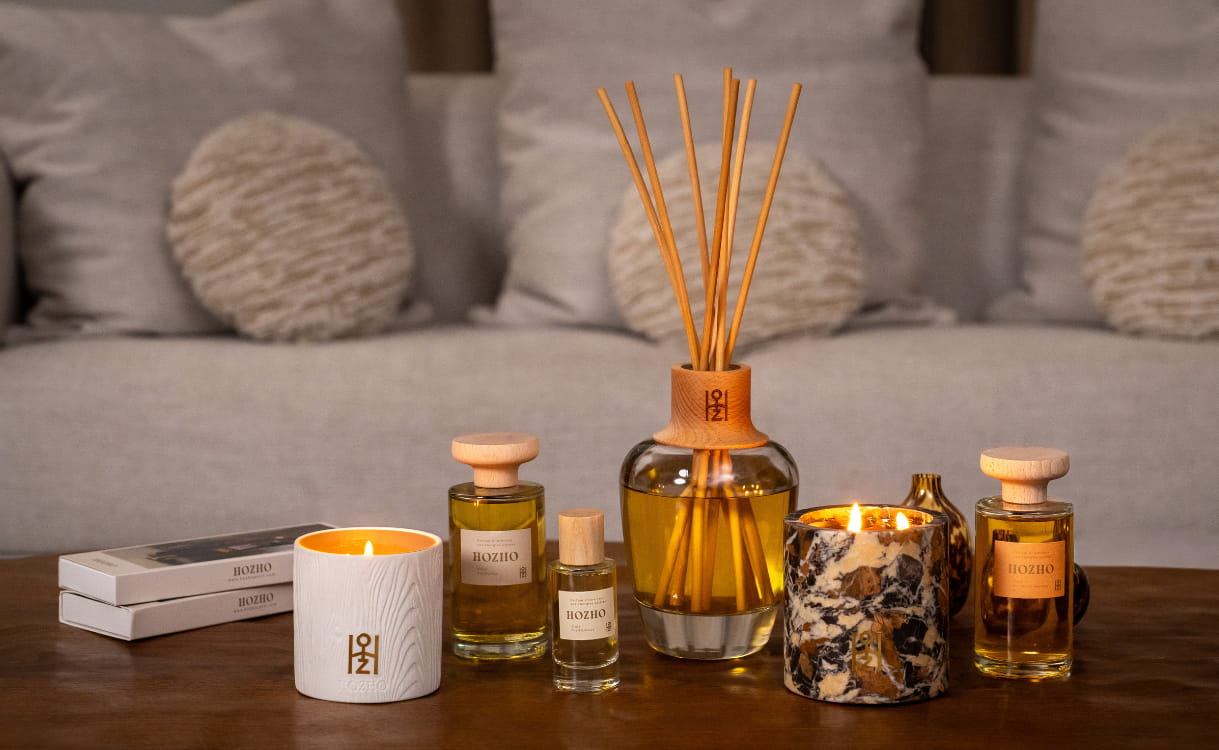
HOZHO energy-cleansing scented treatments
Certain objects, such as candles or home fragrances, are also at the heart of our rituals. They can punctuate a key moment of the day, stimulate our "happiness hormones," and harmonize the energies of our spaces.
This is the case with HOZHO energy-cleansing scented treatments, designed to raise our vibrational frequencies. These energetic perfumes invite us to find harmony with our environment. Because remember: conscious decor is not a punishment! We don't feel guilty for loving our objects—quite the opposite. We honor them by giving them meaning in our lives again.
Where to start to decorate with consciousness?
Proceed room by room, with one intention per week. Set yourself 7-day challenges to do this. The first day, choose a room and formulate an intention such as: "I want to feel soothed, focused, or full of energy."
For a week, remove three objects that no longer speak to you and integrate those that have meaning for you. Also take into account colors, materials, plants, and smells. At the end of the week, observe what has changed and how your mood is.
Have you just moved in? Consult our article on the memory of walls and learn how to cleanse it. Also discover which plants to choose and where to place them with our guide: "17 anti-bad vibe plants for your home."
Your questions, our answers about conscious interior decoration
What is conscious decor in one sentence?
Conscious decor is choosing every object mindfully for what it brings into our lives and the emotions it stimulates. For example, keeping that vase inherited from your grandmother because it tells a story, a lineage, rather than accumulating objects that follow a trend and say nothing about you.
What is the rule of 3 in decoration?
The rule of 3 consists of grouping objects in odd numbers, playing with heights and materials to balance a composition. It is a classic interior design rule, but it does not apply specifically to mindful decoration.
What mistakes should be avoided when starting?
Buying everything at once, copying a trend seen online, or emptying everything. Conscious decoration is built slowly, as it requires listening to yourself and sometimes testing different arrangements before finding the right one. If you hesitate to give away an object, leave it out of sight for a while and then see if you missed it or if you take pleasure in seeing it again.
Does it take a big budget to redecorate your home?
No, conscious decoration does not require a big budget to implement. You can start by rearranging what you have, decluttering, and finding a few second-hand objects. It is primarily about prioritizing reuse, sustainability, authenticity, and simplicity.
Sources: Saxbe, D. E., & Repetti, R. L. (2010). No Place Like Home: Home Tours Correlate With Daily Patterns of Mood and Cortisol. Personality and Social Psychology Bulletin.